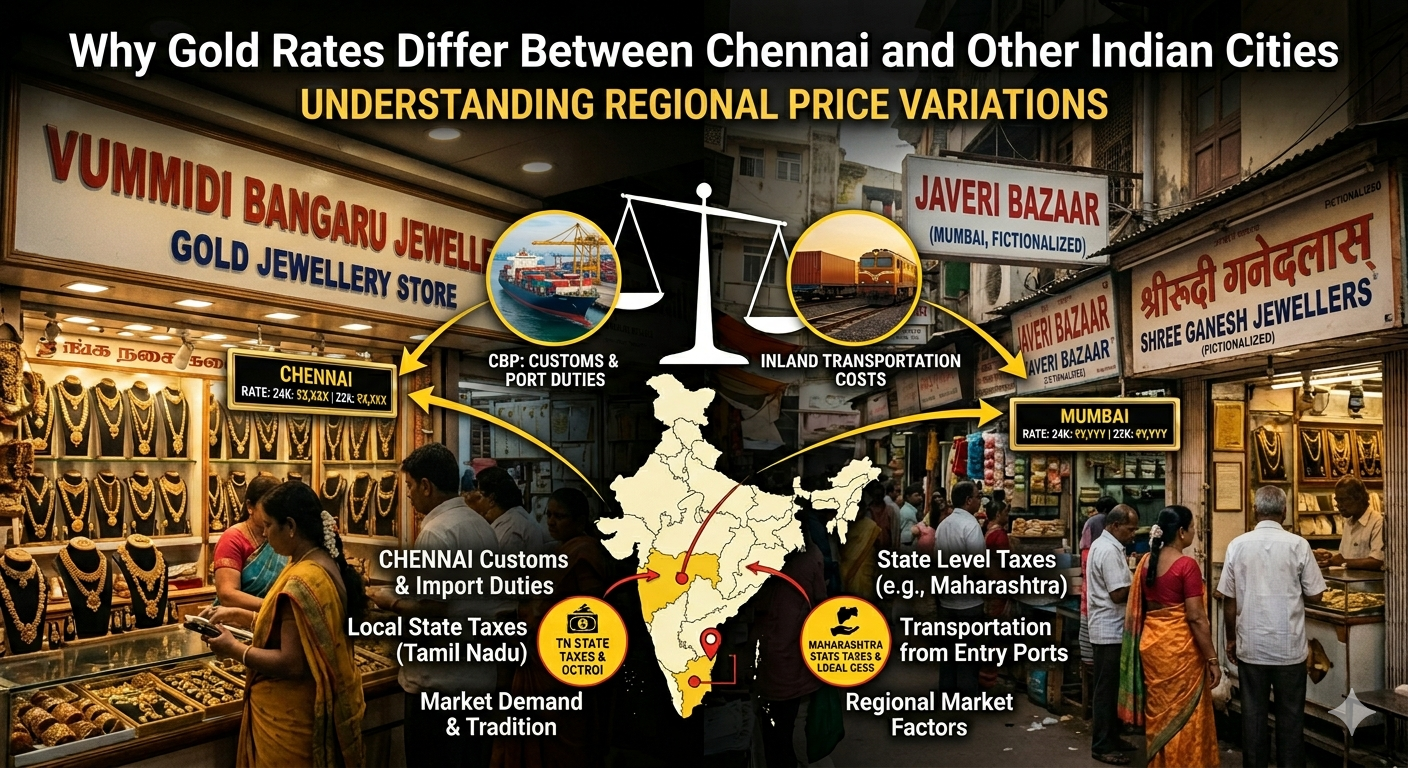
State-Level Taxes and Their Impact on Gold Prices
Gold transactions in India attract a uniform 3% GST nationwide. However, prior to the GST era (before July 2017), state VAT rates on gold varied significantly — some states charged 1%, others up to 2% or more. These historical differences partly explain why gold price benchmarks developed differently in major trading cities. Under the current GST regime, the tax component is uniform, but pricing habits and local premiums have lingered.
Tamil Nadu also levies an octroi-equivalent local cess in some municipalities, and logistics costs for importing gold from Mumbai — the primary bullion trading hub — add a small premium to prices in Chennai compared to Mumbai prices. This premium is typically ₹10–50 per gram on 999 gold and translates to similar differentials on 22-karat jewellery rates.
Tamil Nadu's Historical Gold Price Premium
Chennai and Tamil Nadu have historically maintained slightly higher gold prices than Mumbai. Part of this reflects transportation and insurance costs for physically moving gold from the bullion warehouses near Mumbai's MCX to Tamil Nadu's retail markets. Another factor is Tamil Nadu's exceptionally high per-capita gold consumption — consistently among the highest in India — which keeps local demand strong and allows sellers and dealers to maintain a modest price premium.
For sellers, the Chennai premium typically means your gold buyer's benchmark rate is slightly higher than Mumbai-centric national averages suggest. When comparing IBJA rates (which are set in Mumbai) to what Chennai buyers quote, expect Chennai buyers to add a small regional markup on top of the IBJA base — this is normal and reflects local market conditions rather than inflated margins.
Practical takeaway: Gold rates in Chennai are typically ₹20–80 per gram higher than Mumbai rates on any given day, due to transportation and local demand. Do not use Mumbai-published rates as your benchmark if you are selling in Chennai — use the rates quoted by local buyers, verified against the IBJA published rates for the day.
What This Means for Sellers Choosing When and Where to Sell
For most Chennai-based sellers, the practical implications of regional pricing are modest. You are selling locally and will be paid at local rates — the small premium over Mumbai rates works in your favour. Travelling to another city specifically to sell gold at a different rate is rarely economical once transportation and time costs are factored in.
What matters more is the day-to-day movement in gold prices, the margin your specific buyer takes, and the accuracy of their purity testing — all of which have a far larger impact on your final payout than the ₹30–50 per gram regional premium. Focus on choosing the right buyer and getting accurate testing rather than trying to arbitrage between cities.
Tags