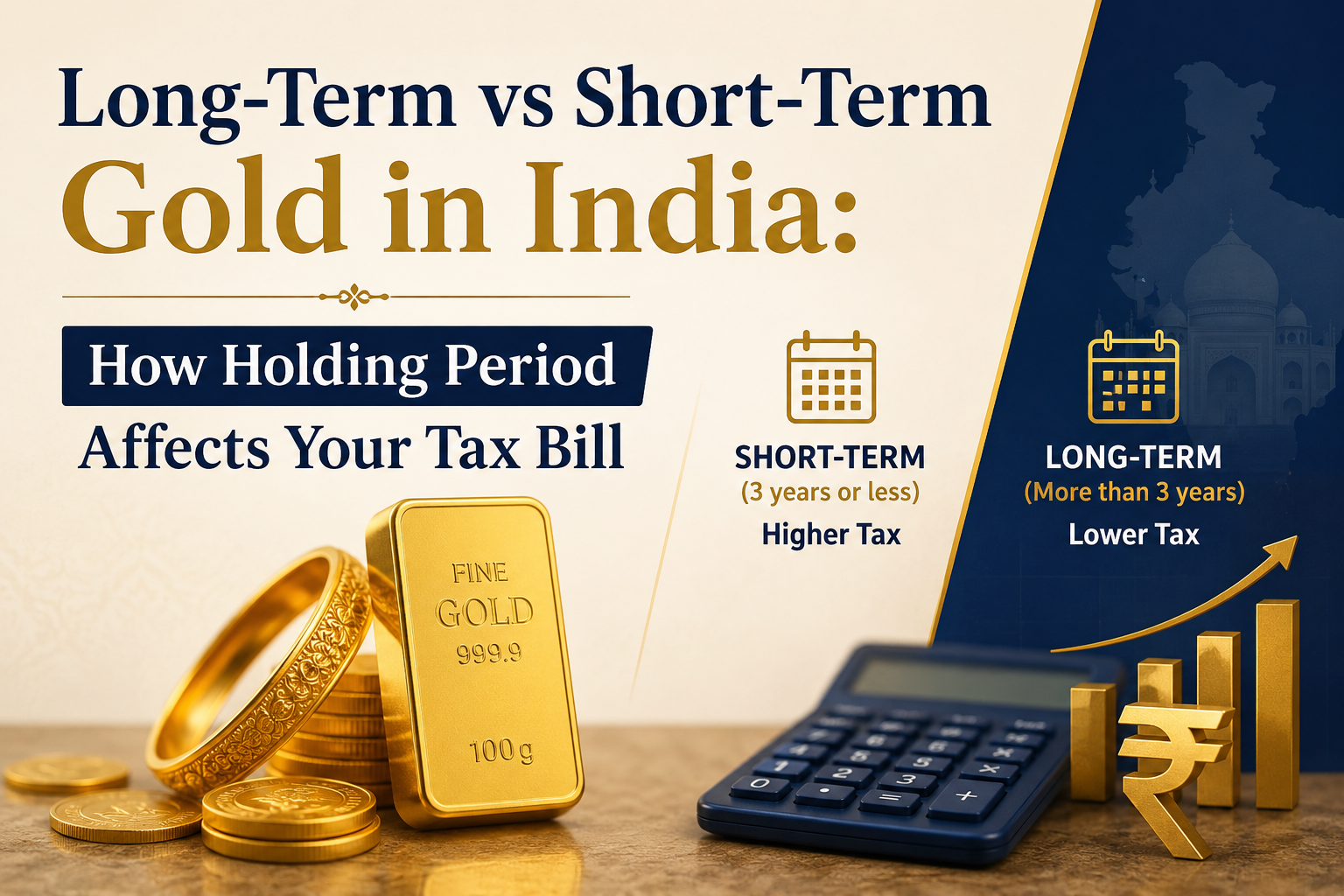
The 24-Month Threshold and Why It Matters
India's income tax law draws a bright line at 24 months of holding for physical gold. Gold sold within this period is Short-Term Capital Asset — and the gain is added to your income and taxed at your marginal slab rate. Gold sold after this period is a Long-Term Capital Asset — and the gain is taxed at a flat 12.5%, regardless of how high your income is.
For a Madurai seller in the 30% income slab who made a ₹2 lakh gain on gold: STCG tax is ₹60,000 (30%). LTCG tax is ₹25,000 (12.5%). The difference of ₹35,000 is a strong incentive to plan your sale date around this threshold.
Practical Example: The Tax Saving from Waiting
Suppose you bought 30 grams of gold in June 2023 for ₹1.8 lakh and the current market value is ₹2.5 lakh. If you sell in April 2025 (22 months of holding), the ₹70,000 gain is STCG and taxed at your slab. If you sell in September 2025 (27 months of holding), the same ₹70,000 gain is LTCG at 12.5%.
For a 30% bracket taxpayer: waiting 5 months saves ₹70,000 × (30% – 12.5%) = ₹12,250 in tax. For a ₹70,000 gain, saving ₹12,250 by simply delaying the sale is a meaningful return — especially if gold prices remain stable or increase during the wait.
Planning tip: If you are approaching the 24-month mark on significant gold holdings and have no urgent cash need, wait until you cross the threshold before selling. Set a calendar reminder 25 months after your gold purchase date as your earliest tax-efficient sale date.
When Holding Longer Is Not Worth It
The tax advantage of holding to LTCG status assumes gold prices remain stable or improve. If gold prices are falling significantly, the tax saving from waiting may be eroded by a lower sale price. At some point, selling at a higher price and paying STCG produces a better net result than waiting for LTCG status at a lower price.
Additionally, if your annual income is below the basic exemption limit (₹3 lakh for the new regime), STCG on gold added to your income may still result in zero tax — making the 24-month threshold irrelevant for very low-income sellers. Know your own tax position before assuming the LTCG threshold always matters.
Tags