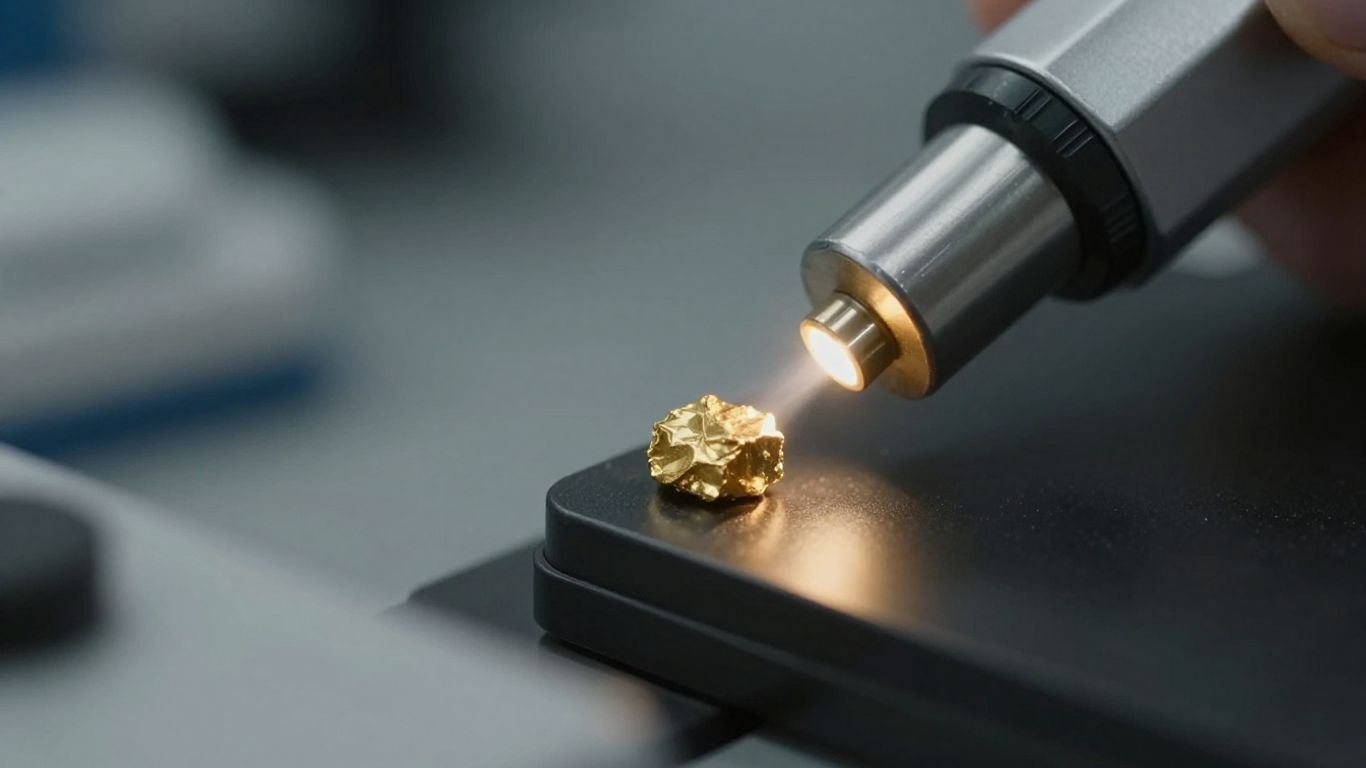
What XRF Testing Is and How It Works
X-Ray Fluorescence (XRF) testing is a scientific technique that bombards a gold sample with X-rays, causing the metal's atoms to emit secondary X-rays at wavelengths specific to each element present. A detector inside the XRF machine reads those emissions and calculates the exact percentage of gold, silver, copper, and other metals in the alloy — all in under 60 seconds.
The key advantage is that the process is completely non-destructive. The jewellery is placed on a sensor bed, the machine runs its scan, and the piece is returned undamaged. You can see the full elemental breakdown on the machine's screen in real time — including the exact gold percentage, which directly determines your offer price.
How XRF Compares to Acid and Touchstone Testing
The traditional touchstone method involves rubbing gold on a black stone and applying nitric acid to the resulting streak. The acid reaction gives a rough indication of purity, but with a margin of error of ±2–3 fineness points. For 916 gold, that could mean a difference of ₹130–200 per gram.
Fire assay — melting the gold and chemically separating the pure metal — is the most accurate method overall, but it is destructive and takes days. XRF sits between these methods: more accurate than touchstone (±0.1% or better on most portable units) and completely non-destructive. For retail sellers, XRF offers the best combination of speed, accuracy, and safety.
Your right as a seller: You are entitled to see the XRF reading before accepting or rejecting an offer. If a buyer performs the test and then quotes a price without showing you the screen, ask them to display the result. Transparency at this stage is a minimum standard of fair practice.
Why XRF Results Can Be Your Best Negotiating Tool
If the XRF machine shows your jewellery is 921 fineness — slightly above the 916 standard — a transparent buyer will price it accordingly, paying you for 921 rather than rounding down to 916. This small difference adds up meaningfully over a large lot. Similarly, if one buyer's XRF shows 916 and another buyer's older or cheaper machine shows 905, the discrepancy itself tells you something about the equipment quality and the buyer's reliability.
Sellers who walk in knowing what the expected purity should be — from an original hallmark or previous testing — are far less likely to be underpaid. Use the XRF result to verify the hallmark claim, and if they match, you have full confidence in the price calculation.
Tags