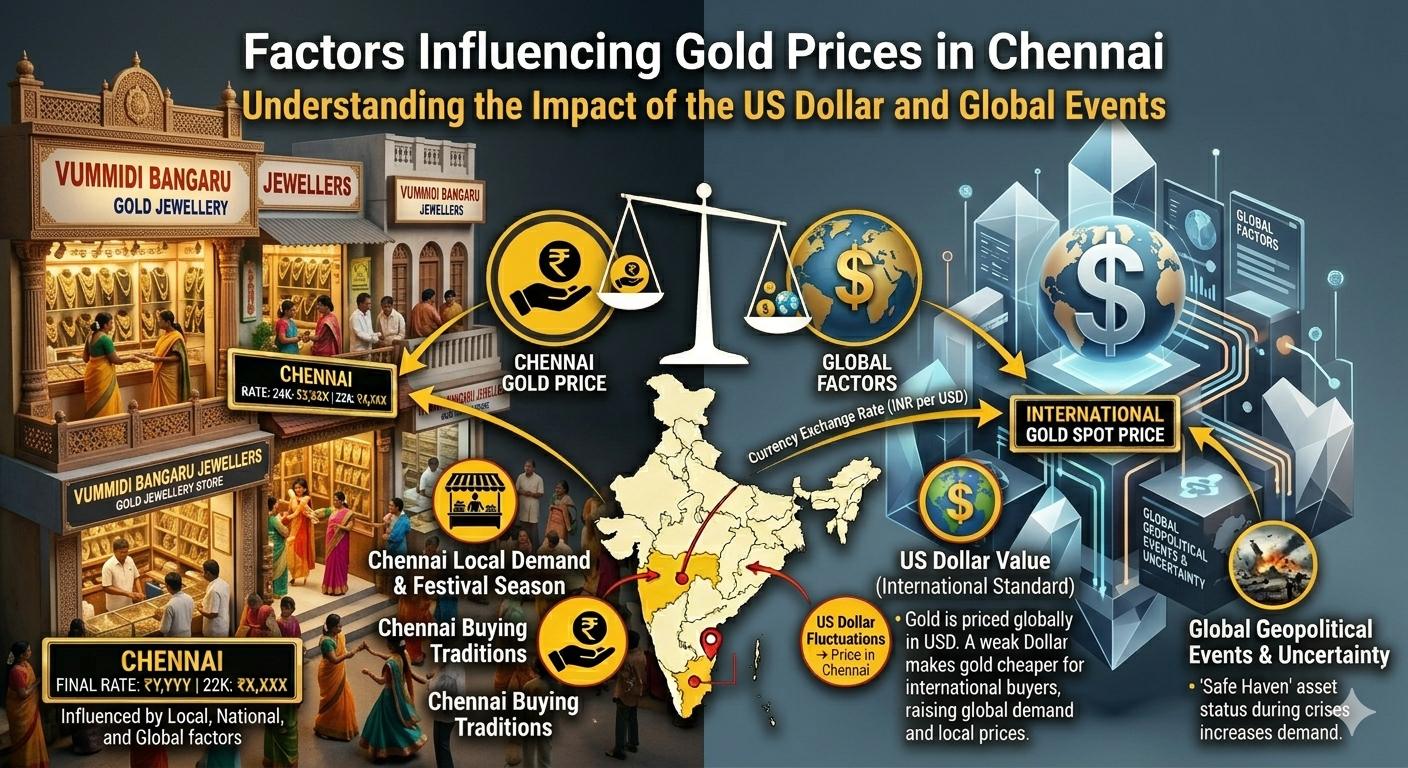
The Dollar-Gold Inverse Relationship
Gold is priced globally in US dollars. When the dollar strengthens against other currencies, the international gold price (in USD) tends to fall — because gold becomes more expensive in dollar terms for non-US buyers, reducing demand. When the dollar weakens, gold becomes cheaper for non-US buyers, increasing demand and pushing up the USD price.
For Indian sellers, this creates a two-way impact. If the USD gold price rises but the rupee also strengthens against the dollar, the gains can partially offset each other. Conversely, a weakening rupee amplifies a rising USD gold price: both factors push the Indian price higher simultaneously, as happened in 2020 when gold in India reached ₹56,000 per 10 grams while the rupee also weakened.
How Geopolitical Events Drive Gold Prices
Gold is the world's most widely held safe-haven asset. When geopolitical stress intensifies — military conflicts, trade wars, financial system instability — investors globally shift capital from risk assets (equities, corporate bonds) into gold, driving up its price. This is why gold prices typically spike during crises: the Russia-Ukraine war in February 2022 drove gold from ₹49,000 to over ₹53,000 per 10 grams in India within weeks.
Central bank gold buying also matters. Since 2022, major central banks — including the Reserve Bank of India — have significantly increased gold purchases as a reserve diversification strategy. This sustained institutional demand acts as a price floor and has contributed to gold's strong upward trajectory in recent years.
Practical implication for sellers: When geopolitical uncertainty is high and gold prices have recently spiked, the environment is typically favourable for selling. Prices at or near all-time highs are rarely the "best ever" starting point for a long hold — and the risk of reversal is real. If you were planning to sell anyway, a crisis-driven spike is often a good moment to act.
Rupee Depreciation and Its Double Effect on Gold
India imports most of its gold in dollars. When the rupee depreciates against the dollar, gold becomes more expensive to import, and this cost is passed through to domestic prices. A rupee that loses 5% of its value against the dollar will, all else equal, push domestic gold prices up by approximately 5%.
Over the past decade, the rupee has weakened from roughly ₹60/USD to ₹83–85/USD. This currency decline has been a significant driver of higher gold prices in India even in periods when the international USD gold price was flat. For sellers, a weakening rupee environment is structurally supportive of gold prices over the medium term.
Tags