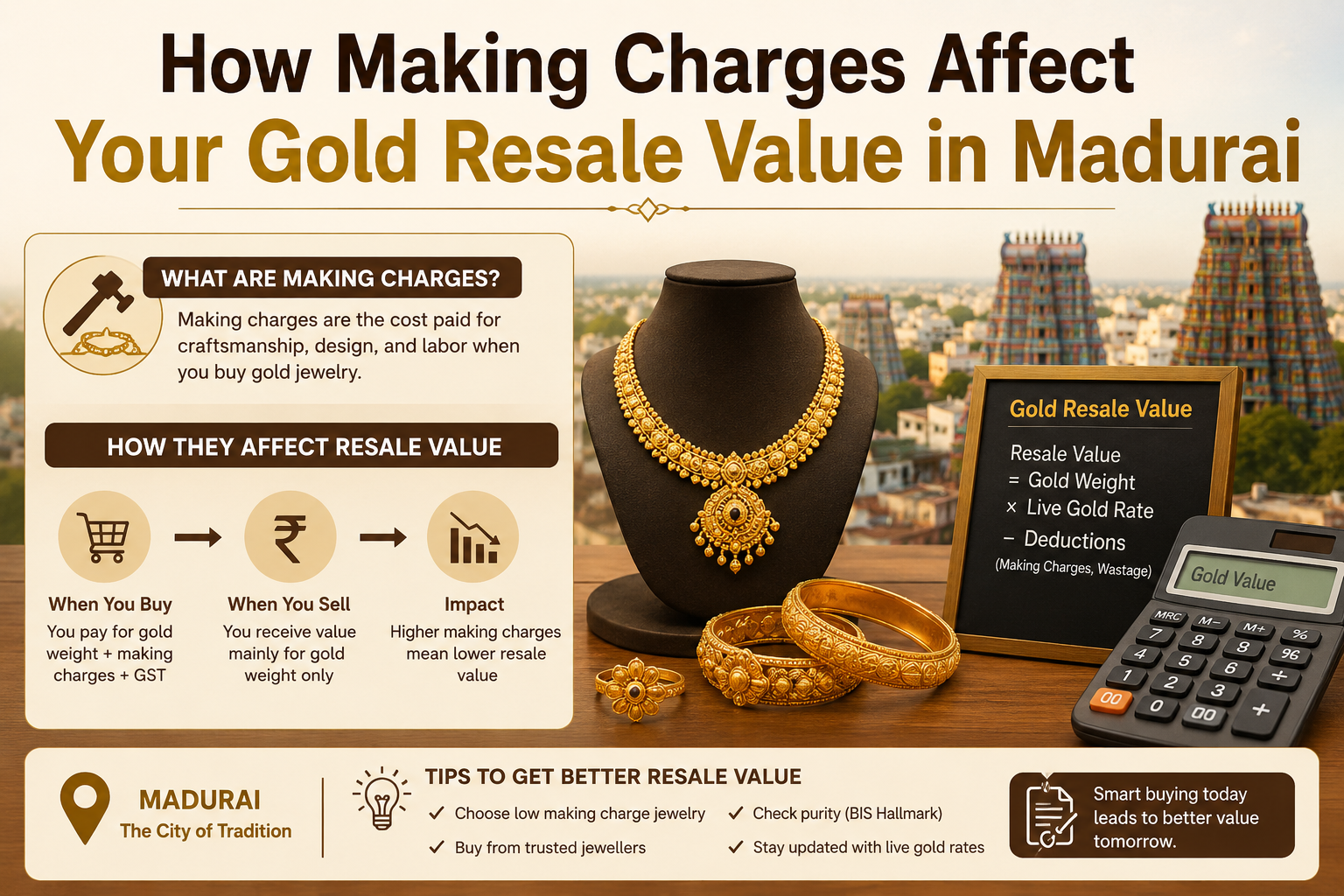
What Making Charges Actually Are
Making charges are the fee a jeweller adds to the cost of gold to cover labour, design, equipment, and profit from craftsmanship. They are typically expressed as a percentage of the gold value or as a flat rate per gram. For standard chains, the making charge might be 8–12%. For handcrafted Madurai temple jewellery, Kundan work, or traditional bridal sets, charges can reach 25–40% or more because of the intensive labour involved.
When you purchase a gold necklace from a Madurai jeweller, your invoice will show a gold component (weight × today's rate × purity) and a separate making charge line. The making charge portion is a service fee — not an investment that appreciates with gold prices.
Why Making Charges Disappear When You Sell
When you sell your jewellery to a gold buyer in Madurai, they are purchasing the metal, not the artistry. The buyer will melt the piece and sell the refined gold as bullion. The design has no commercial value — it will cease to exist after refining. Therefore, the price they pay is based solely on the melt value: net gold weight × purity × prevailing rate, minus their margin.
This means a ₹90,000 necklace — of which ₹65,000 was gold and ₹25,000 was making charges — will sell for approximately ₹63,000 at today's rates (assuming prices are unchanged since purchase and the buyer takes a 3% margin). The ₹25,000 in making charges is permanently lost at resale.
Making charges example: A 10-gram 22-karat necklace at ₹7,000/gram gold rate = ₹64,120 gold value (916 purity) + 12% making charges = ₹7,694. Total purchase price: ₹71,814. Resale offer at same rate: approximately ₹62,200. The ₹9,600 difference is primarily the making charge — permanently gone at resale.
Which Jewellery Types Have Lower Making Charges
For Madurai sellers who also plan to buy gold in the future, choosing jewellery with lower making charges reduces the effective cost of the making-charge gap. Plain gold coins and biscuits carry the lowest making charges (typically 1–3%). Simple round bangles and thick chains are next (5–8%). Intricate temple necklaces, jhumkas, and elaborate bridal sets sit at the higher end.
Gold coins issued by banks like SBI or backed by MMTC carry even lower premiums and are easier to resell at near-market rates — making them a better choice for investors who plan to liquidate within a few years rather than hold indefinitely.
The Melt Value Is What Matters When Selling
The single most useful number to understand before walking into any gold sale in Madurai is your jewellery's melt value. Calculate it as: (net gold weight in grams) × (purity as a decimal) × (today's IBJA rate per gram for 999 gold). This gives you the maximum theoretical value of the gold content. A fair buyer offer should be within 3–5% of this figure.
If you find a significant gap between your calculated melt value and the offer, ask the buyer to walk through their calculation step by step. The most common sources of unexplained gaps are: a lower purity assessment than expected, an inflated stone or fixture deduction, or an excessive margin. All of these can be challenged with the right information in hand.
Tags