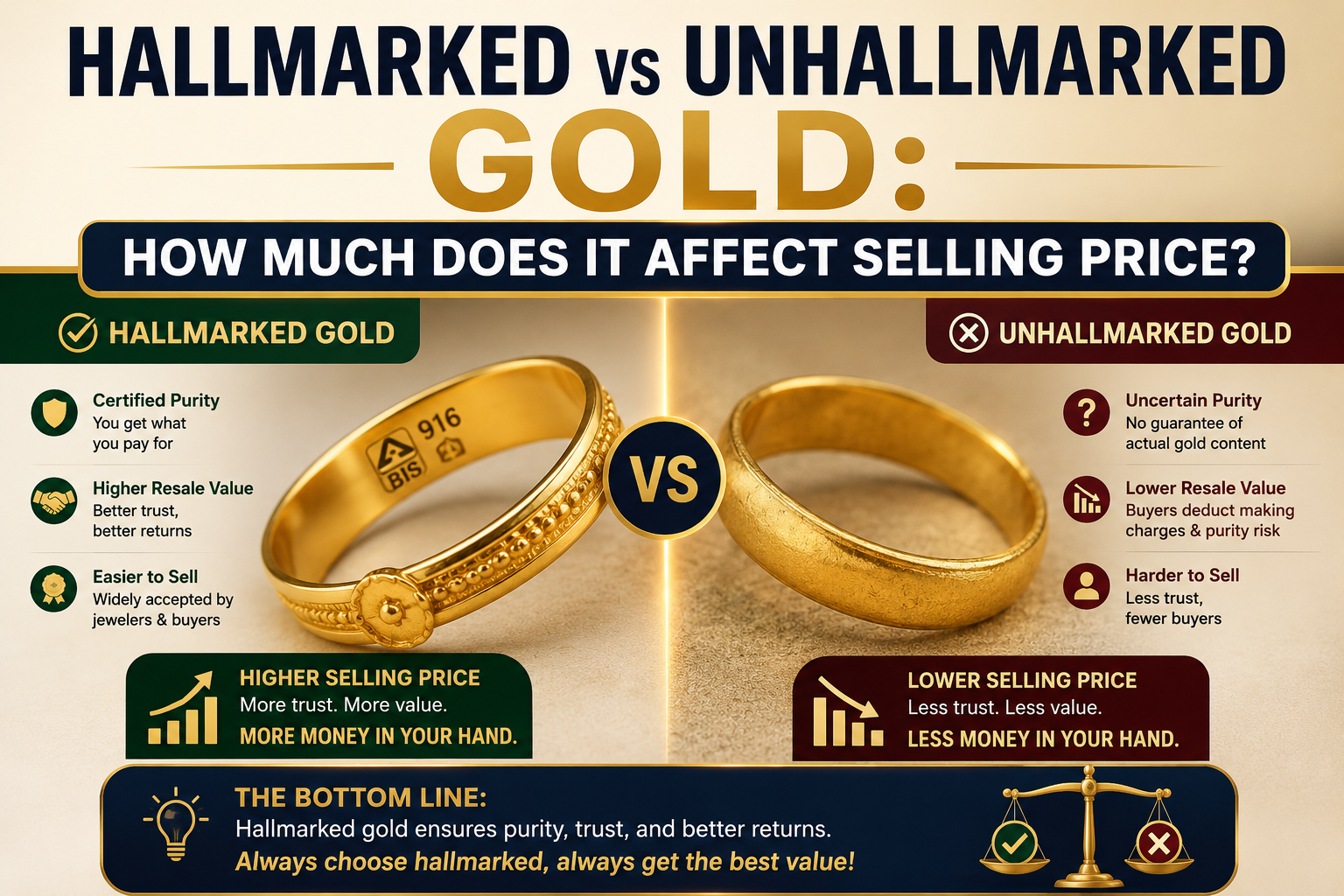
What Hallmarking Actually Means for Your Gold
When you bring gold to a buyer, the first question they need to answer is: how pure is this piece? A BIS hallmark — issued under the Bureau of Indian Standards — gives a certified, tamper-evident answer to that question. Since January 2022, BIS hallmarking has been mandatory for gold jewellery sold by licensed jewellers in India, and the mark now includes a six-digit alphanumeric HUID (Hallmark Unique ID) that can be verified instantly through the BIS Care app.
The hallmark tells the buyer — and you — the exact fineness of your gold. A 22-karat piece is marked 916 (91.6% pure gold), an 18-karat piece is marked 750, and a 14-karat piece is marked 585. These fineness values are the foundation of any price calculation. The IBJA (India Bullion and Jewellers Association) publishes standard gold rates daily in Mumbai, and Chennai buyers typically reference these rates adjusted to local premiums when making you an offer.
In short, a hallmark is not just a quality symbol — it is a pricing anchor. Without it, buyers must make assumptions about purity, and those assumptions almost always work against the seller.
How Buyers Price Hallmarked Gold
For a BIS-hallmarked piece, the calculation is straightforward. Take the current IBJA spot rate for 24-karat gold (typically published in rupees per 10 grams), multiply it by the fineness of your piece, then factor in the net weight of pure gold after deducting stone weight and any metal alloys.
For example, if the IBJA 24K rate is ₹7,200 per gram and you have a 916-hallmarked chain weighing 10 grams net, the gold value is approximately ₹65,952 (7,200 × 0.916 × 10). A reputable buyer in Chennai will offer you a percentage of this — typically between 90% and 97% of the calculated gold value, depending on the buyer's margin and your ability to negotiate.
The key advantage here is zero ambiguity. Both you and the buyer are working from the same certified number. There is no deduction for uncertainty, no arbitrary purity downgrade, and no reason for the buyer to hedge their offer. The hallmark removes doubt, and that removal has real rupee value in your pocket.
Important fact: BIS hallmarked gold in India can also be exchanged or sold back at most jewellery chains under standardised buyback schemes — hallmarking makes your gold liquid in more places, not just at gold-buying counters. In Chennai, major jewellers like Lalitha Jewellery and GRT Jewellers often accept only hallmarked pieces for direct exchange buyback.
The Hidden Cost of Unhalmarked Gold
Unhalmarked gold creates a problem that is entirely practical: the buyer cannot take your word for its purity. This is not a personal judgment — it is a business reality. Without certification, the buyer must test the piece themselves, and even with testing, they carry residual risk if their equipment or process has any margin of error.
To compensate for this uncertainty, buyers typically apply a purity discount. In Chennai's resale market, unhalmarked gold is commonly priced as though it is one purity tier lower than what testing suggests. A piece that tests at 916 (22K) on a touchstone or basic XRF scanner may be offered at 875 or even 750 fineness rates unless the buyer is highly confident in their equipment and trusts the reading completely.
What does this mean in rupees? Using the same ₹7,200 per gram rate: a 10-gram piece treated as 916 is worth ₹65,952 in gold value. The same piece priced at 875 fineness drops to ₹63,000 — a difference of nearly ₹3,000 on a single transaction. On larger pieces — say a 50-gram set of wedding jewellery — this gap could exceed ₹15,000. The discount is not symbolic. It is a real transfer of money from you to the buyer to cover their uncertainty.
Additionally, unhalmarked old jewellery from small family workshops — common in Chennai households that have held gold for 20–30 years — may have genuinely inconsistent purity. Some older 22K pieces from the 1980s and 1990s were made to slightly lower actual purity than claimed, making buyers even more cautious with unverified pieces.
Should You Get Hallmarking Done Before Selling?
This is the practical question most sellers in Chennai ask, and the honest answer is: it depends on the value of your gold and how quickly you need to sell.
Getting BIS hallmarking done through an Assaying and Hallmarking Centre (AHC) — there are several NABL-accredited centres operating across Chennai including in areas like Sowcarpet, T. Nagar, and Anna Nagar — costs roughly ₹35 to ₹45 per piece and typically takes one to three working days. For a single ring or pendant worth a few grams, the fee might not justify the wait. But for a heavy necklace, a full bridal set, or accumulated loose pieces totalling 50 grams or more, the cost of hallmarking is trivial compared to the pricing premium it unlocks.
Here is a simple framework to help you decide:
- Less than 10 grams total: Skip hallmarking. The time and fee rarely justify the marginal gain. Choose a buyer with reliable in-house testing equipment instead.
- 10 to 30 grams: Consider hallmarking if your pieces are old and purity is genuinely uncertain. A certified result protects you from lowball offers.
- More than 30 grams: Strongly consider hallmarking before selling. The pricing difference alone is likely to cover the fee many times over.
One more consideration: if your gold is already tested and confirmed at 916 or 750 fineness by a buyer using a calibrated XRF machine — the type used by professional gold buyers in Chennai — then hallmarking may be redundant for that transaction. Ask your buyer how they test and what their purity discount policy is for unhalmarked pieces before making the trip to an AHC.
Seller tip: Before accepting any offer for unhalmarked gold, always ask the buyer to show you the purity reading on their testing device and explain exactly which fineness rate they are using to calculate your price. A trustworthy buyer in Chennai will do this transparently — if they refuse or quote a vague percentage, treat that as a red flag and get a second opinion.
The Bottom Line for Chennai Gold Sellers
Hallmarking is ultimately about information parity. When both you and the buyer know the exact purity of your gold, the negotiation is fair and the price you receive reflects the actual metal content. When purity is unknown, the buyer carries the risk — and you pay for it through a lower offer.
In Chennai's competitive gold resale market, where buyers range from organised retail chains to independent gold merchants in Sowcarpet and T. Nagar, sellers with hallmarked pieces consistently receive better offers and close transactions faster. You are not just selling metal — you are selling certainty, and certainty commands a premium.
If your gold is hallmarked, bring your HUID number with you and verify it on the BIS Care app before your appointment. If it is not hallmarked and the quantity justifies the effort, a quick visit to an accredited centre in Chennai could put thousands of extra rupees in your hand. Either way, walk into the transaction informed — the price difference between a confident seller and an uninformed one can be significant.
Tags